
Read 1 Chronicles 16 here (text coming …) or at Bible Gateway.
The Hebrew paragraphs:
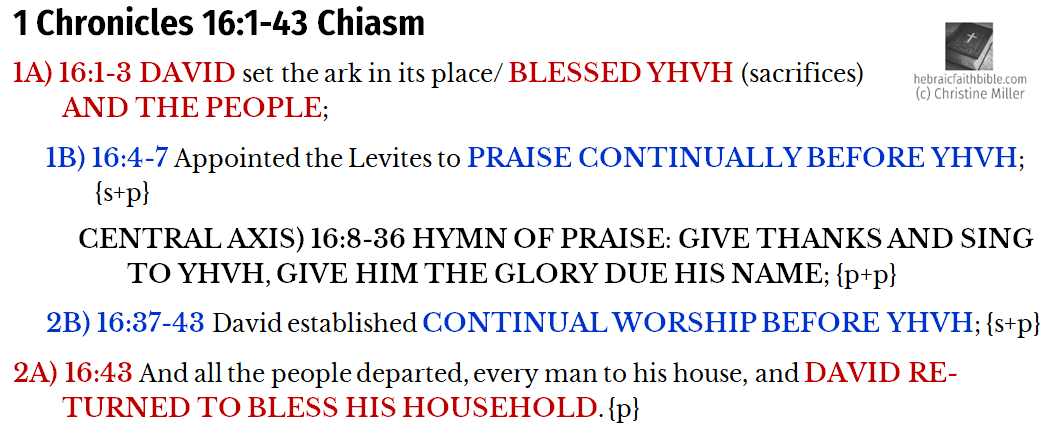
16:1-4 {s} David set the ark in its place/ blessed YHVH (sacrifices) and the people/ appointed the Levites to praise
16:5-7 {p} David ordained Asaph and his brothers to give thanks continually before YHVH
16:8-22 {p} Give thanks to YHVH/ remember His wondrous works
16:23-36 {p} Sing to YHVH all the earth/ give Him the glory due His name
16:37-38a {s} He left Asaph and his brothers before the ark to serve
16:38b-43 {p} The priests at the tabernacle at Gibeon to do according to the Law
The Strong themes:
15:3-10 {sx6+p} David gathered Israel, and the priests and Levites to Jerusalem to bring up the ark of God
15:11-15 {s+p} David called the priests and Levites to sanctify themselves to bring up the ark of God
15:17-25 {s+p} The Levites appointed gatekeepers, singers, musicians, a music master, gate-keepers for the ark
The Chiastic structure:
Glory in His holy name; let the hearts of those who seek YHVH rejoice. 1 Chr 16:10
When we consider that David appointed Levites to rejoice before YHVH continually, it begs the question, can joy be commanded?
Joy is in Hebrew, Strong’s H8057, simcha, “joy, mirth, gladness;” from Strong’s H8056, sameach, “joyful, merry;” from Strong’s H8055, שמח samach, “to rejoice.” The ancient pictographs are sin + mem + chet. According to the Ancient Hebrew Lexicon, the original sin was transposed to the shin due to their similar sounds.
sin ס = thorn (grab, hate, protect)
mem מ, ם = water (chaos, mighty, blood)
chet ח = wall (outside, divide, half)
When water (mem) lies on the fields outside (chet), it glistens in the sun, becoming bright. Thus the parable told by the Hebrew Root Word: to turn (sin, as one turns away from a thorn if it is encountered in the path) to a glistening (mem + chet) aspect, or countenance.
Does the parable for “to rejoice” imply someone can turn away from a downcast aspect to a glistening, joyful one? I believe, yes! If we choose to focus on our blessings (forget not all His benefits, Psa 103:2) and praise Him for them – admittedly as an act of will at first, since we likely won’t feel like it given a downcast emotional state – the feelings do follow when we persist, because they are attached. They’re like the caboose which follows the engine of YHVH’s truth when we choose to rejoice.
If there are questions, this is a good resource:
Feelings, the unreliable barometer – Christine Miller













Leave a Reply