Read 2 Chronicles 3 here (text coming …) or at Bible Gateway.
The Hebrew paragraphs:
2:17-3:7 {s} He appointed the strangers to the labor force and began to build the temple
3:6-13 {s} The construction and description of the Holy of Holies
3:14 {s} He made the veil of blue, purple, crimson, fine linen and embroidered it cherubim
3:15 {s} Two pillars and their capitals in front of the temple
3:16-17 {s} Their decoration and their names
The Chiastic structure:
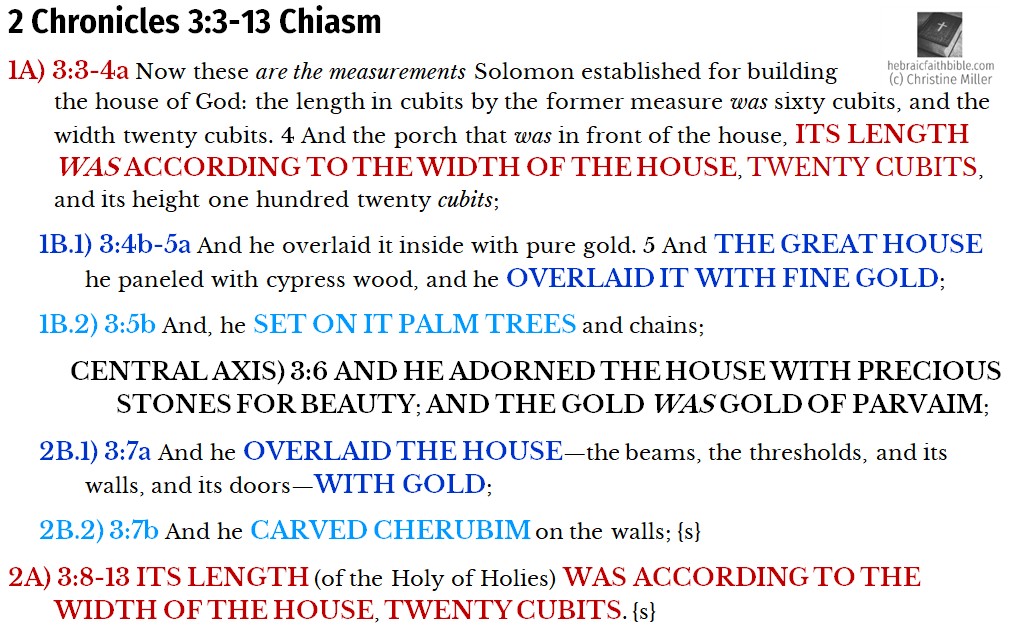
And he adorned the house with precious stones for beauty; and the gold was gold of Parvaim. 2 Chr 3:6
The central axis shines a spotlight on the adornment and beauty of the temple.
Beauty is Strong’s H8597, tipharah, an abstract concept, from Strong’s H6286, פאר pa’ar, ‘to beautify, to be beautiful.’
The verb Strong’s H6509, פרה parah, ‘to bear fruit’ is at the foundation of many cognate words including our word pa’ar, ‘to beautify, to be beautiful,’ through the idea that fruit adorns the boughs of the tree, making it beautiful.
Our Western idea of beauty comes from the Ancient Greeks. Something that was symmetrical and harmoniously proportioned mathematically was beautiful. However, this definition of beauty, while universally affirmed, often only went skin-deep, as a surface aesthetic.
And it came to pass, when they were come, that he looked on Eliab and said, “Surely YHVH’s anointed is before Him!” But YHVH said to Samuel, “Do not look on his appearance or on the height of his stature, because I have refused him. For YHVH does not see as man sees; for man looks on the outward appearance, but YHVH looks on the heart.” 1 Sam 16:6-7
The biblical concept of beauty, however, is tied to fruitfulness. Is the heart of the tree good so that it is its nature to produce good fruit? (Mat 7:17-18) Then it is a beautiful tree, and as the Natural Picture teaches, by extension a beautiful person.
Charm is deceitful and beauty is passing, but a woman who fears YHVH, she shall be praised. Pro 31:30










Leave a Reply