
Read Genesis 20 at Bible Gateway.
The Hebrew paragraph:
Gen 20:1-18 {s} Abimelech takes but then restores Sarah, Abraham’s wife
The Chiastic Structure:
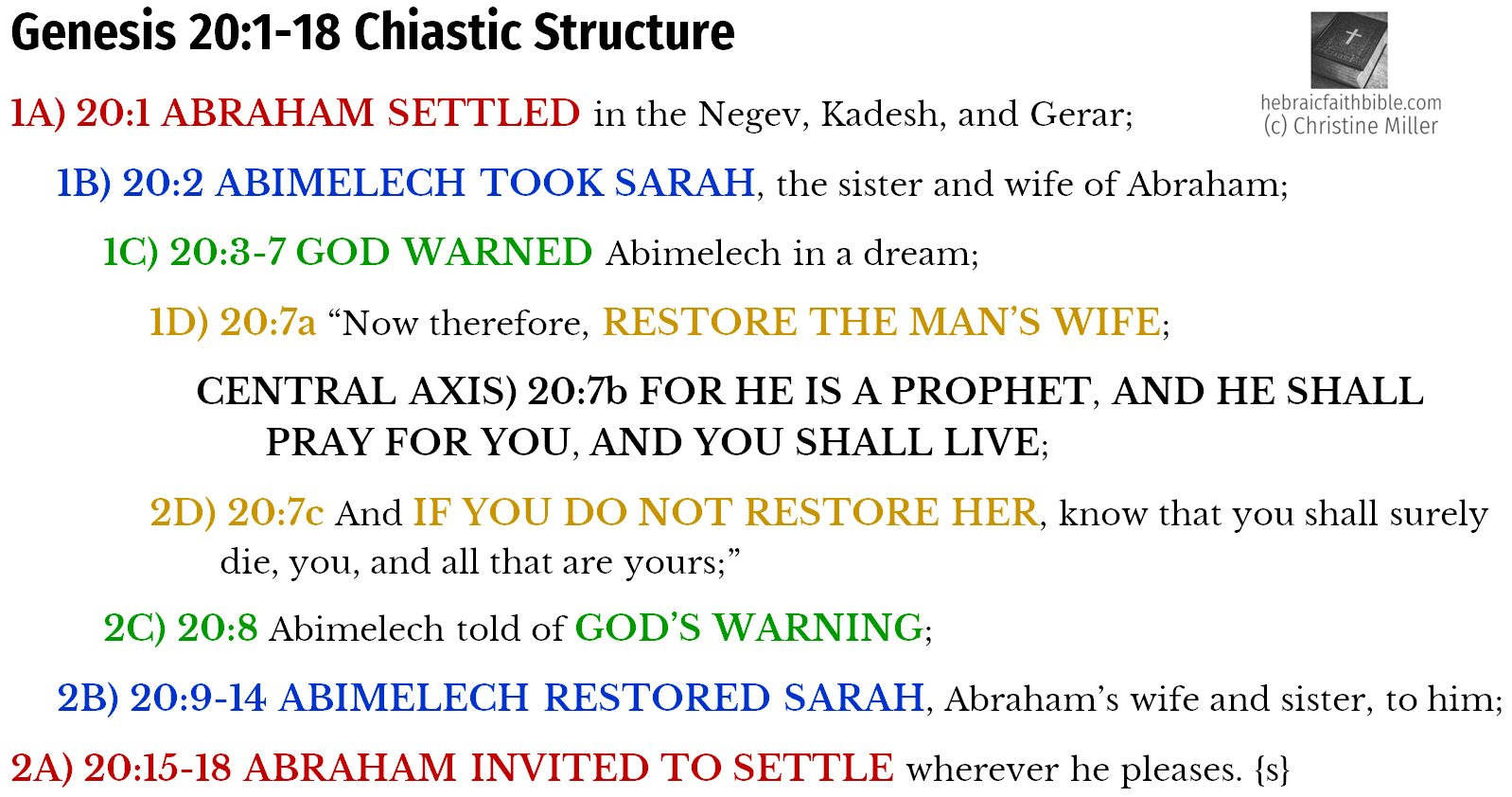
The central axis contains the first occurrence in the Bible of “prophet,” from Strong’s H5012, נבא naba, “to cause to bubble up.” The ancient pictographs are nun + bet + aleph.
nun נ ן = seed (continue, heir, son)
bet ב = house (house, household, family, in, within)
aleph א = ox head (strength, power, leader)
The nun + bet partial tells the story of the seed (nun) inside its house (bet). The concrete noun from this root is ‘fruit,’ as fruits have their seeds hidden within them; the verbal action is ‘to flourish, to be fruitful.’ Adding the aleph nuances the Hebrew Root Word parable to the seed (nun) within (bet) which leads (aleph).
The seed is the Word of God (Luk 8:11). The word is hidden within the heart (Psa 119:11). But it is so powerful that it takes great effort to restrain it there so that it doesn’t come to the surface (Jer 20:9). Thus the abstract concept from the root is ‘prophecy,’ that seed which is hidden, but which is so powerful that it bubbles up.
We don’t think of Abraham as a prophet like Isaiah or Jeremiah; he did not preach “Thus saith the LORD” as they did. But he did “speak.” He lived his life in accordance with God’s ways, differently from the pagan world around him.
“For I have known him, in order that he may command his children and his household after him, that they may keep the way of YHVH, to do righteousness and justice, that YHVH may bring upon Abraham what He has spoken to him.” Gen 18:19
Why This Matters: The central axis reveals that prophecy and prayer are two sides of the same coin. A prophet speaks on God’s behalf to men, and one who prays speaks on man’s behalf to God.
If there are questions, these are good resources:
The Index of Hebrew Roots – Christine Miller
Who was Abimelech? – Christian Answers











Leave a Reply