Read James 1 here (text coming …) or at Bible Gateway.
The Greek Testament does not contain paragraph markers.
The Chiastic structure:
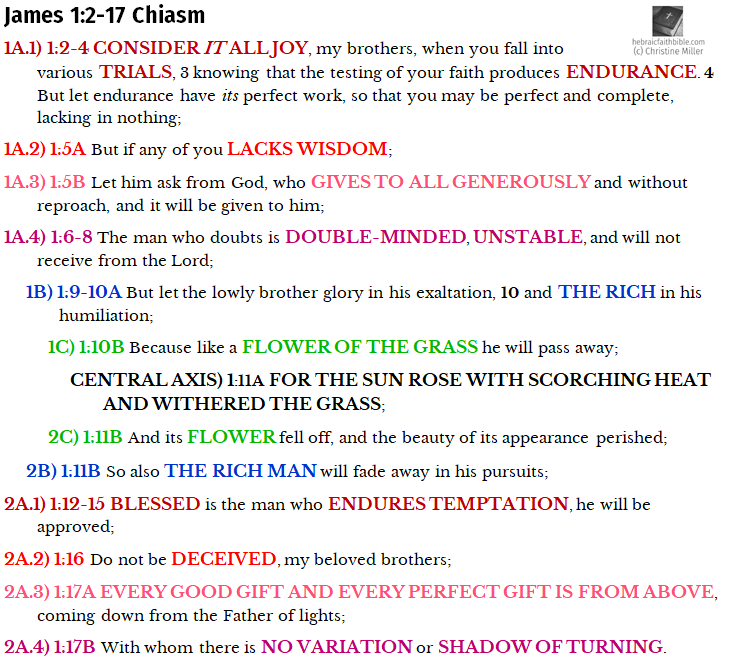
Consider it all joy, my brothers, when you fall into various trials, knowing that the testing of your faith produces endurance. But let endurance have its perfect work, so that you may be perfect and complete, lacking in nothing. Jam 1:2-4
A trial is a circumstance that tries us. It stretches our patience, or resources, or mental or physical capacity in some way. We are out of our comfort zone. No one is immune from falling into trials, as James puts it. These adverse life circumstances require us to put the full weight of our life on the promises God has made. We are like a man crossing a footbridge he has never encountered before. He must step out onto the bridge in faith, hoping that it will hold him. When it does, he has tested the bridge’s strength and found that it supported him. This faith produces endurance.
Endurance, according to Webster’s, is the ability to withstand hardship or adversity. The Hebrew word is “wait,” as in, “But those who wait for YHVH shall renew their strength,” Isa 40:31. When we remain steadfast and faithful in our trial, waiting for our promised deliverance, or intervention by the hand of YHVH, then endurance, or strength, is the result.
What perfect work does endurance bring about? “Perfect,” as it is defined biblically, does not mean “flawless” as we often imagine. Instead, think of it as something finished, completed, or arrived at its goal. The goal of faithful endurance is maturity. We grow up into the faith.
In the structure, the trials we endure pairs with the temptations we endure. Trials can be thought of as external pressure, or the adverse circumstances of life. Temptations can be thought of as internal pressure, when our desire for something unwise or unrighteous conflicts with what we know we ought to do or not do.
Interestingly enough, the ‘trials’ of verse 2, and the ‘temptation’ of verse 12 is the same word in Greek, Strong’s G3986, πειρασμός peirasmos. And the ‘testing’ of verse 2 (Strong’s G1383 δοκίμιον), and the ‘approval’ of verse 12 (Strong’s G1384 δόκιμος) are related in Greek, painting the picture of a weapon with a honed edge enabling it to cut as it was designed to do. Testing the weapon’s mettle leads to its approval as well-crafted when it passes the test.
If there are questions, this is a good resource:
Temptations, Tests, and Trials – Christine Miller












Leave a Reply