
Read James 5 here (text coming …) or at Bible Gateway.
The Greek Testament does not contain paragraph markers.
The Chiastic structure:
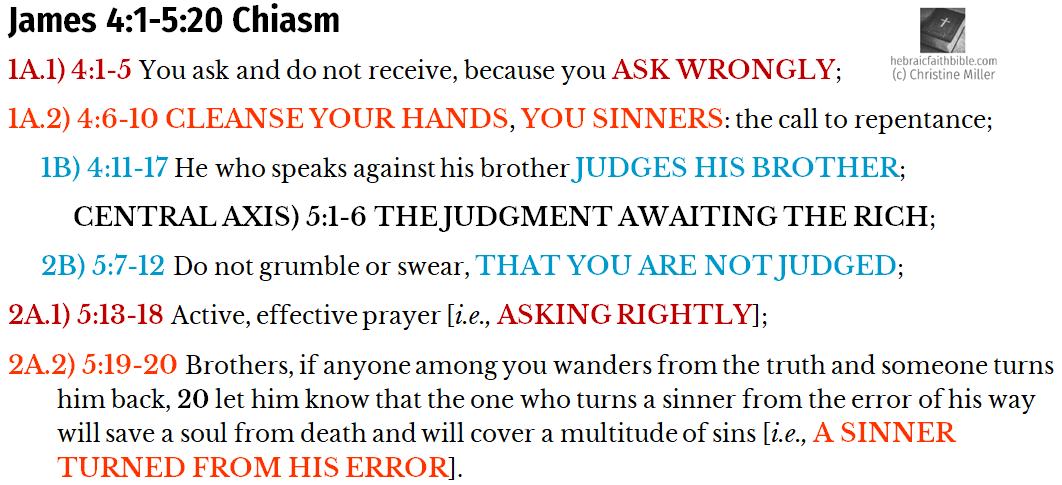
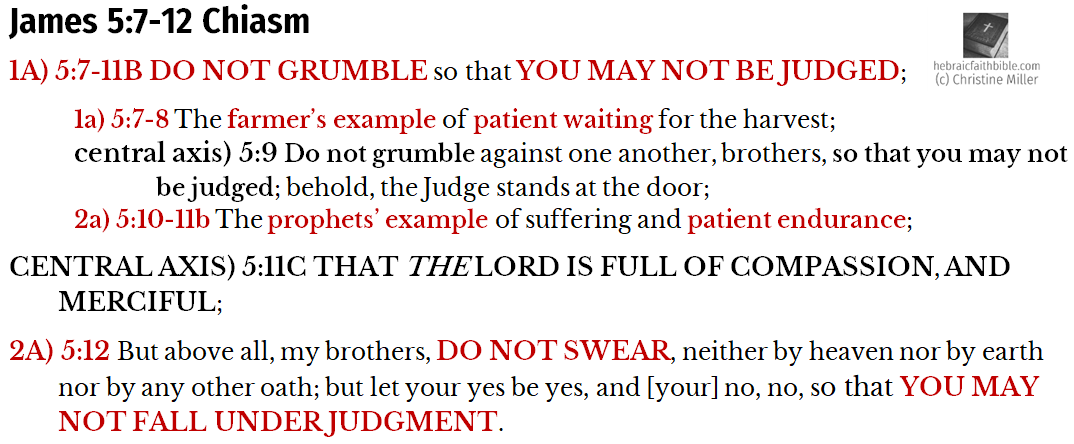
Do you notice that all of the admonitions involving judgment have to do with the mouth? Speaking against (Jam 4:11), grumbling against (vs. 9), and swearing (vs. 12), recalling the chapter 3 polemic against the unruly tongue which is set on fire by Hell.
Speaking against is Strong’s G2635, καταλαλέω katalaléō, a broad term for slander or gossip. It literally means “to traduce”(Strong’s); that is, “to expose to shame or blame by means of falsehood and misrepresentation” (Webster’s). Its Hebrew equivalent via the Septuagint is Strong’s H1696 דבר dabar, “to speak,” i.e., to set words in order, with “against” implied by context.
Grumbling against is Strong’s G4727, τενάζω stenázō, “to groan or sigh in complaint.” Its Hebrew equivalent via the Septuagint is Strong’s H7878, שיח siyach, “to germinate,” either of new shoots, or of the thoughts of the mind, to consider thoughts and speak them. When we take the negative that has grabbed hold (sin) within, and throw it (yud) outside (chet), we err, as expressing the disquietude of our heart or mind about another, to others, risks bearing false witness against another.
Swearing is Strong’s G3660, ὀμνύω omnýō, “to take or declare an oath.” Its Hebrew equivalent via the Septuagint is Strong’s H7650, שבע shaba, “to swear, to take an oath.” The Hebrew Root Word parable is of that which passes through the teeth (shin, i.e., spoken words) which the family (bet, not just those who share the same tent, but also the entire extended clan) will watch over (ayin) to ensure compliance.
So, to avoid an inadvertent sin, let your yes be yes, and your no be no, and set a guard over your mouth; keep the door of your lips (Psa 141:3) to prevent the escape of complaining or disparaging thoughts.


















Leave a Reply