
Read Job 18 and 19 at Bible Gateway.
Hebrew paragraph divisions
For the series of speeches from Job 3:2-28:10, the Hebrew paragraph divisions for each man’s speech are like the divisions in the Psalms that we studied in 2014. There is an understood {s} division at the end of each numbered line, with an {n} marking where a new line begins within a numbered line. There are no {n} divisions in the speech from Job 16:1-19:29.
Job 18 is Bildad’s speech, which I cannot find a chiastic structure for. Job 19 is his reply to Bildad.
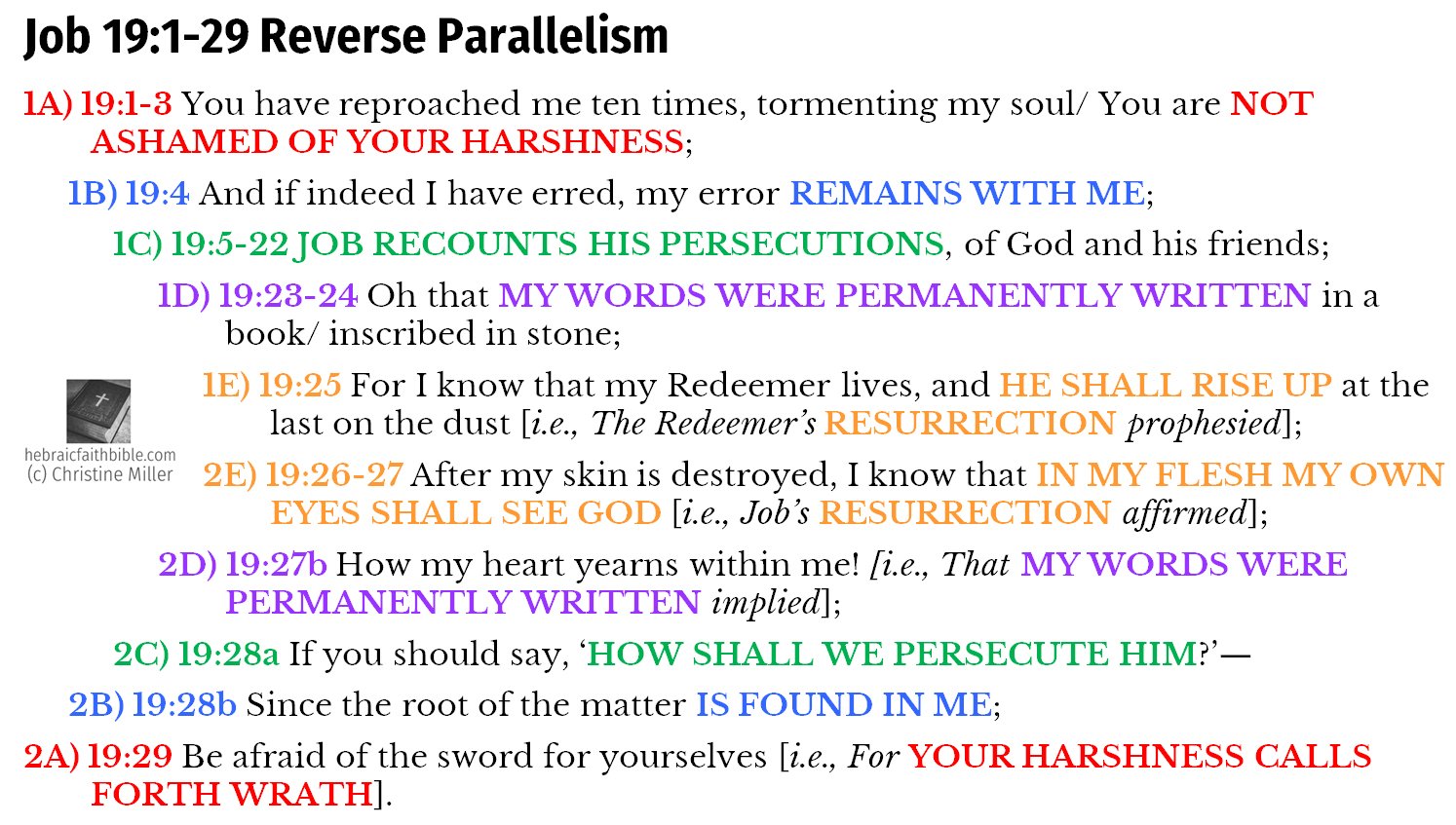
The D pair, as far as I can tell, pairs in that what his heart is yearning for, is that his words would be permanently written in a book.
The E pair is the central axis.
1E: Even in the JPS, “Redeemer” is capitalized, indicating that the Redeemer referred to is God, and He shall arise up and stand on the dust. “Dust” is meant, Strong’s H6083, aphar, as in, God formed man of the dust of the earth; and not “earth” more commonly rendered from Strong’s H776, eretz, as in, In the beginning God created the heavens and the earth. It matters that it is dust, because it is to dust that men return when they die, so that Job is prophetically speaking of the resurrection of the Redeemer.
2E: Again Job’s subject is resurrection, but this time he is speaking of his own, for after his skin is destroyed, after he himself goes to the dust, he knows as surely as he knows his Redeemer lives, that in his flesh he shall see God. He is not talking about his spirit seeing God’s Spirit, or something similarly ethereal in the spiritual realm, for the phrase emphatically included, “in my flesh,” only ever speaks of the flesh and bones of this physical creation.












Leave a Reply