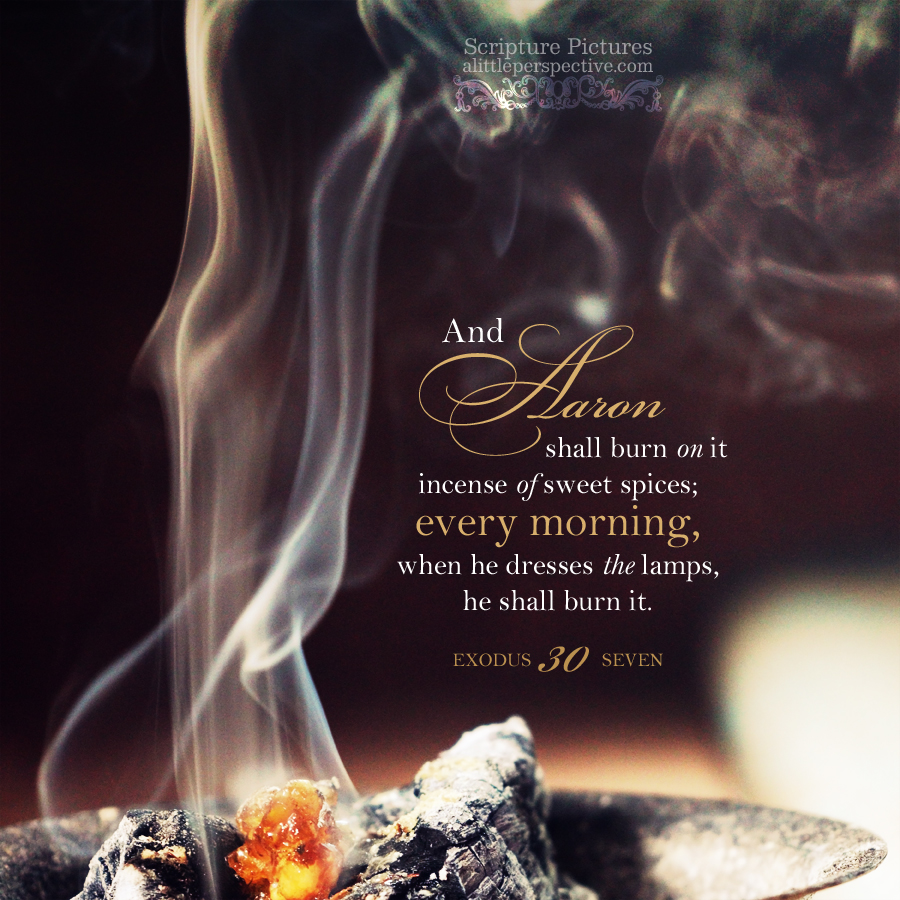
Today’s Hebrew Testament chronological reading is in Exodus 29 and 30.
The Psalms/ Proverbs reading is in Psalm 61.
The Greek Testament reading is in Romans 14.
Essential Studies.
Exodus 30, Created, then Consecrated
Additional studies: Exodus Index
The body of Messiah is the tabernacle or dwelling place of the Holy Spirit (1 Cor 3:16). God first makes us His dwelling place, by the process of salvation, but He does not stop there. Then He sets about the second stage: sanctifying or consecrating us. As we learn His ways (admittedly a process which takes time) we put off that which is common and worldly, and put on that which is holy and pleasing to Him. Church, do not fear to walk in the ways of God as expressed by His commandments. When you do so, you are not making void the grace of Messiah for salvation in trying to become justified before God by righteous works, as a certain sect was who was troubling the Galatians was teaching. You are merely cooperating with His Spirit in becoming set apart for Him! ♥
Psalm 61, Overwhelming distress to exultant praise
Additional studies: Psalms Book Two (42-72) Index
The faint heart, according to Gesenius’ Hebrew Lexicon, is a heart that is wrapped in darkness; from its primitive root of being shrouded or covered over. Thus David’s location at the end of the earth. In Hebrew poetry, “the end of the earth” often isn’t literal geography but a metaphor for extreme distance, isolation, or desperation. It’s as if David feels utterly remote at the world’s edge, being at the “farthest reaches” from God’s presence. He’s calling to YHVH for rescue. The Chiastic Structure makes a Contrast in the B pair, from being at the utmost extremity from God, to dwelling in His tent forever.
Romans 14:1-4, Disputes over doubtful things
Additional studies: Romans Index
The letters Paul wrote, which we have preserved in the New Testament, are not actually stand- alone letters. They were written in response to letters sent to him by the new churches – or else to reports given to him by brothers coming to and from the churches. We only have his replies; we do not have the original letters, so we can only guess, from clues in his reply, what the question was that he was expounding on in his response. Because we only have half the equation, it is even easier than usual to make a wrong assumption about the topic under discussion. I mean, we saw how easy it was to make a wrong assumption about the topic under discussion from the Gospels when we thought Jesus was discussing clean and unclean food, and in that case we had all the facts up front. So in the Epistles we need to be even more careful because we do not have all the facts up front. We need to be sure that our assumption and the conclusions drawn from our assumption harmonizes with the rest of Scripture. Keep reading …
Three-year Bible.
The three-year plan is here.
Today’s reading is in Psalm 85 and 86.
Suggested study: Psalm 85, Bible for Beginners, and Psalm 86, Bible for Beginners.







Leave a Reply