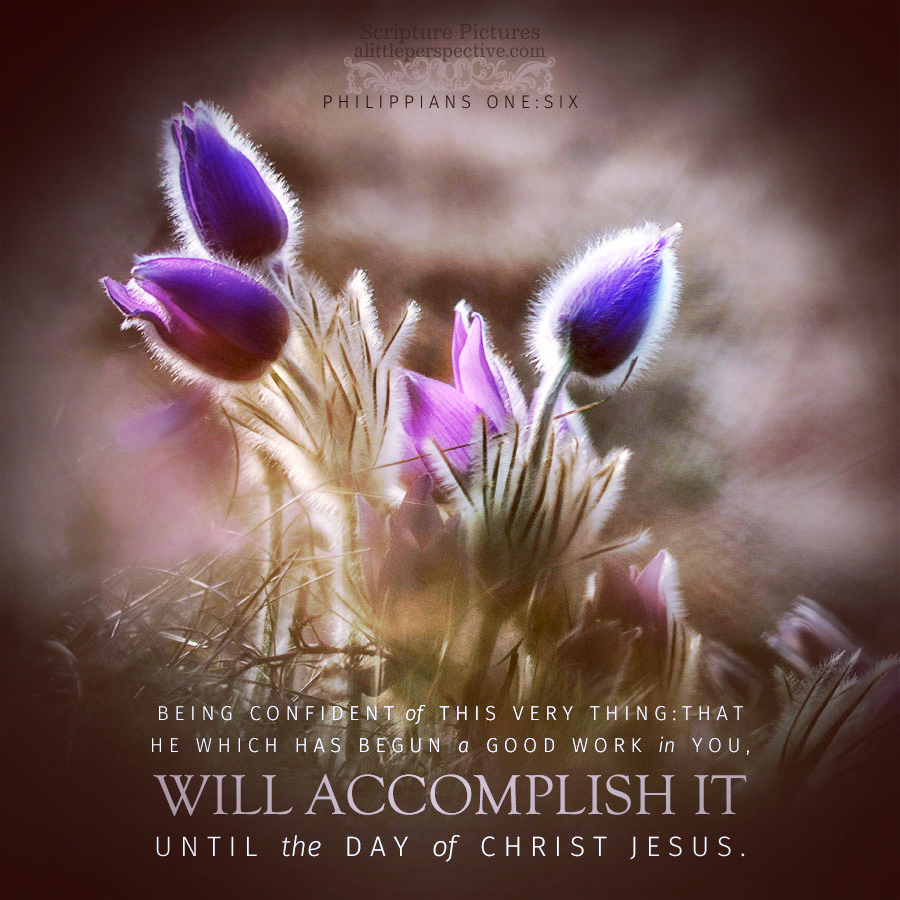
Read Philippians 1 here (text coming …) or at Bible Gateway.
The Greek Testament does not contain paragraph markers.
The Chiastic structure:

To be confident is in Greek, Strong’s G3982, πείθω peíthō, “to persuade, to be persuaded.” The Hebrew equivalent via the Septuagint is Strong’s H982, בטח batach, “to trust.” The ancient pictographs:
bet ב = house (house, household, family, in, within)
tet ט = basket (surround, contain, hold, mud)
chet ח = wall (outside, divide, half)
The Hebrew Root Word parable is of the family (bet) surrounded by (tet) the wall (chet). The abstract concept from this verbal root is security, because the family is secure within its house.
To begin is in Greek, Strong’s G1728, ἐνάρχομαι enárchomai, “to begin, to make a beginning.” According to Vine’s, the root arch primarily indicated what was of worth, so that the verb archo meant “to be first,” and archon denoted “a ruler.”
This verb does not appear in the Septuagint, so there is no direct comparison there. However Hebrew also has the same idea of that which is first, so that “beginning” (“In the beginning,” Gen 1:1) is Strong’s H7225 re’shiyth, “beginning, firstfruits;” from Strong’s H7218 rosh, “head;” from an unused, unnamed verb meaning, “to shake.” The ancient pictographs for the noun:
resh ר = head of man (head, first, top, beginning, man)
aleph א = ox head (strength, power, leader)
shin ש = two front teeth (sharp, press, eat, two, again)
The parable is of the head (resh) who has the power (aleph) to give his assent or denial (shin, i.e., a head nod of assent or shake of denial is a movement made again and again).
To begin is to have a starting point, to come into existence, to bring into being, to found, according to Webster’s; and it is the head who has the authority and the ability to found.
To complete is in Greek, Strong’s G2005, ἐπιτελέω epiteléō, “to accomplish.” Its Hebrew equivalent via the Septuagint is Strong’s H6965, קום quwm, “to arise.” The ancient pictographs:
quph ק = sun on the horizon (condense, circle, time)
vav ו = tent peg (add, secure, hook)
mem מ ם = water (chaos, mighty, blood)
The related words will help us find the story. The verb is “to arise,” and its concrete noun is a standing grain stalk. A stalk or a plant arises and stands up when it gathers (quph, as light leaves the earth and sky to be gathered to the sun when it is on the horizon) to itself (vav, in the context of adding) water (mem) drawn up from the root.
The meaning of fulfillment, accomplishment comes from a word spoken, or a project begun which “stands up” or proves to be so, when it is completed.
Who are you to judge another’s servant? To his own master he stands or falls. Indeed, he will be made to stand, for God is able to make him stand. Rom 14:4







Leave a Reply