
Read Proverbs 27 here (text coming …) or at Bible Gateway.
The Hebrew paragraphs:
26:22-27:22 {p} Betrayal and loyalty: what is in the heart will reveal itself in due time
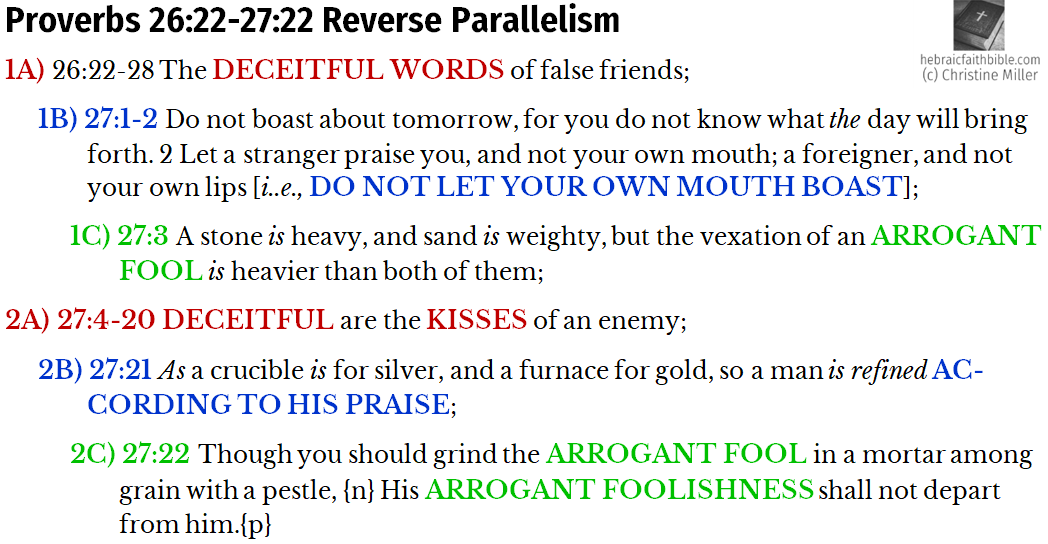
Proverbs 26:22-27:22 Reverse parallelism
Proverbs 27:15-20 Chiastic structure:
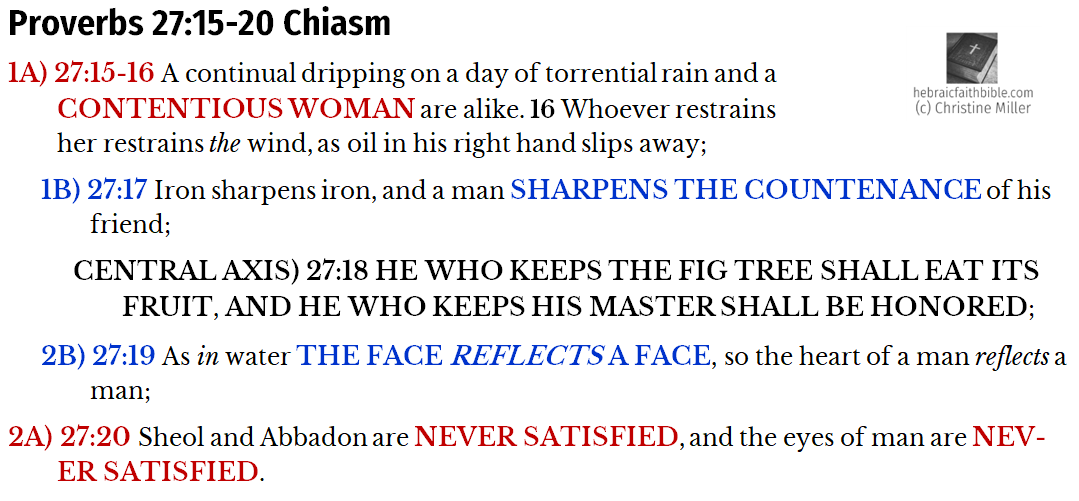
Let’s unpack the structure. The A pair:
‘Contentious’ and ‘contentment’ share a root (content).
To be contented, according to Webster’s, is to be satisfied with one’s possessions, status, or situation. The contented woman is satisfied with the content of her life.
To be contentious, according to Webster’s, is to exhibit a perverse and wearisome tendency to quarrels and disputes. That Proverbs juxtaposes a contentious woman with a contented one reveals that the root of the contentious woman’s quarrels is her dissatisfaction with the content of her life. She has complaints about her possessions, status, and situation.
The funny thing, is that the content of someone’s life rarely has a bearing on their satisfaction or dissatisfaction. People with little can be deeply satisfied, while people with much can be supremely dissatisfied. It has more to do with the state of one’s heart than the actual content of their lives.
So, the contented woman is satisfied, while the contentious woman always has complaints, and is never satisfied, just as Sheol is never satisfied and the eyes of a man are never satisfied.
The B pair:
The key word is ‘face’ in both vs. 17 and 19.
Iron sharpens iron, and a man sharpens the countenance (literally ‘face’ in Hebrew) of his friend. Pro 27:17
As in water the face reflects a face, so the heart of a man reflects a man. Pro 27:19
Face is Strong’s H6440, paniym, “face;” from Strong’s H6437 פנה panah, “to turn oneself,” that is, to turn the face toward. The ancient pictographs:.
pey פ ף = mouth (open, blow, scatter, edge)
nun נ ן = seed (continue, heir, son)
hey ה = man w/ upraised arms (look, reveal, wonder, worship, breath)
The Hebrew Root Word parable is to open (pey) the seed (nun), meaning the root is going down; so the face bowed down (pey + nun) in worship (hey). Dr. Benner in the Ancient Hebrew Lexicon writes of the meaning:
The face, also the presence of one through the sense of being in the face of.
Thus a man turning his face to YHVH is to seek Him or to worship Him; and YHVH turning His face to man is to cause His presence to descend to him and receive his worship.
In this structure, the implication is that a man will sharpen, or refine, his friend’s character (indicated by the face or countenance as the presence of a man). And, that just as a pond will reflect the face that looks into it, so a man will reflect his heart, revealing his character.
If there are questions, this is a good resource:
Keys to Contentment – Christine Miller















Leave a Reply