These are some of the paintings I was able to get a decent picture of. I am learning how to hold the camera straight toward the flat surface I am photographing. Bear with me, I am trying to improve, lol.
-
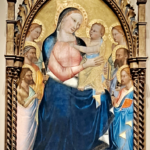
- Giovanni del Biondo Italian, active in Florence by 1356, died 1399 Virgin and Child with Saints, ca. 1385-90 Tempera and gold on panel In this opulent panel, lavish quantities of gold, intricate tooling articulating haloes and garments, and other details create an overall effect of sumptuous complexity. It also contributes to the impression of heaven as a distant, otherworldly, and unattainable realm, typical of paintings in 14th century Italy. Indeed, the tender interaction between the Virgin and her Child is perhaps the only recognizably human element. This panel originally stood at the center of a larger altarpiece.
-
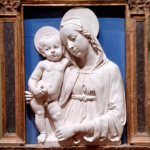
- Andrea della Robbia Italian, 1435-1525 or 1528, active in Florence Virgin and Child, ca. 1490 Glazed terracotta in a painted and gilded frame Images of the Virgin and Child were virtually everywhere in the Renaissance home. In the 1300s and 1400s representations of the Virgin and Child became increasingly tender. The relief sculpture here is meant to recall carved marble, rather than the more inexpensive terracotta of which it was made.
-
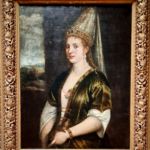
- Workshop of Titian (Tiziano Vecellio) Italian, 1485/ 90? – 1576 Portrait of a Woman, ca. 1515-20 Oil on canvas Titian was the most important Venetian painter of the 16th century, and his work continued to influence European art long after his death. The woman in this painting is dressed in the style of the Ottoman Empire. Titian and his workshop produced a number of paintings of women in “exotic” dress, to satisfy local demand.
-
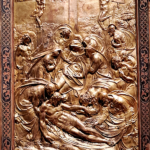
- After a Model by Guglielmo della Porta Italian, Roman, ca. 1500-1577 The Deposition, 1570-85 Gilded bronze This exquisite, small-scale relief made for use in private devotions shows the Deposition of Christ, the moment when He is lowered from the cross. This relief is known in multiple versions, attesting to its popularity among pious patrons of the arts.
-
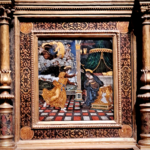
- Venetian The Annunciation, 1600s Reverse painting on glass (verre églomisé) In a lavishly appointed domestic interior, the Virgin bows modestly as the Archangel Gabriel rushes to bring her the news that she will bear the Son of God. Prized for its ability to imitate the luminosity and clarity of gemstones, verre églomisé is a type of glass decoration whereby a piece of glass is painted, gilded, or engraved on the reverse. Many compositions done in this style can be traced directly to prints that were circulated widely in the early 16th century. This Annunciation is based on a print by Marco Dente da Ravenna (1486-1527).
-
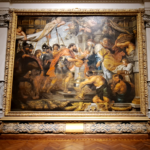
- Peter Paul Rubens, Flemish, 1577-1640 The Meeting of Abraham and Melchizedek, c. 1626 Oil on panel
-
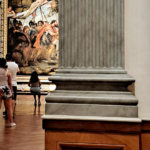
- The Museum was filled with period architectural details, not highlighted as part of the art collection. Intricately carved columns, wall panels, and ceiling molding and plasterwork everywhere attest to Renaissance grandeur. In the background of this column is the several stories tall Rubens painting of Abraham and Melchizedek.
-
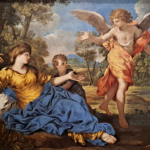
- Pietro da Cortona Italian, 1596-1669 Hagar and the Angel, ca. 1643 Oil on canvas Cortona was one of the key figures in Italian Baroque art, and this painting is an extremely fine example of his work. … Cortona combines weighty, sculptural figures with shimmering contrasts of yellows, greens, and blues to create a scene that is both quietly monumental and eternally energized.
-
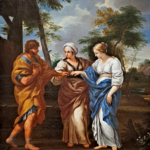
- Workshop of Pietro da Cortona Italian, 1596-1669 Marriage of Jacob and Rachel, 1670s Oil on canvas Pietro da Cortona was one of the most successful painters in 17th –century Rome. This work was executed by Cortona’s workshop soon after his death, following an original composition by the master.
-
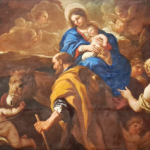
- Luca Giordano Italian, 1634-1705, active in Naples, Florence, Venice, and Madrid The Flight into Egypt, c. 1696 Oil on canvas The Neapolitan painter Luca Giordano executed this work in Madrid while in the employ of the Hapsburg King Charles II of Spain, who appointed him court painter in 1694.
-
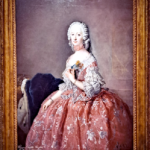
- Workshop of Antoine Pesne French, 1683-1757, active in Prussia Philippine Charlotte, Princess of Prussia and Duchess of Brunswick, ca. 1744. Oil on canvas The inscription, lower left, identifies the sitter as Princess Philippine Charlotte, sister of King Frederick the Great of Prussia. Frederick was a major patron of the arts enamored of all things French. French artists flocked to his court, including Antoine Pesne, who became Frederick’s official portraitist. Philippine Charlotte wears the height of French fashions.
-
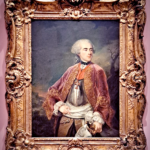
- Portrait of a Gentleman
Dave said to me as we were walking through, “There is one thing this Museum is lacking, and that is portraits of the Holy Family.” Not! He was kidding. Till about halfway through the 1600s the paintings tended toward biblical or spiritual themes. After that, there were portraits of people, historical events or places, mythology, even landscapes, as the detachment from Rome and the Catholic church, and the rise of classical humanism, became more widespread. We enjoyed our visit to the Ringling – thank you, Kiersten!











Leave a Reply