
Read Psalm 57 here (text coming …) or at Bible Gateway.
The Hebrew paragraph:
57:1-11 {p} Desperate need met by God’s gracious steadfast love and truth
Psalm 57:1-11 Reverse Parallelism:
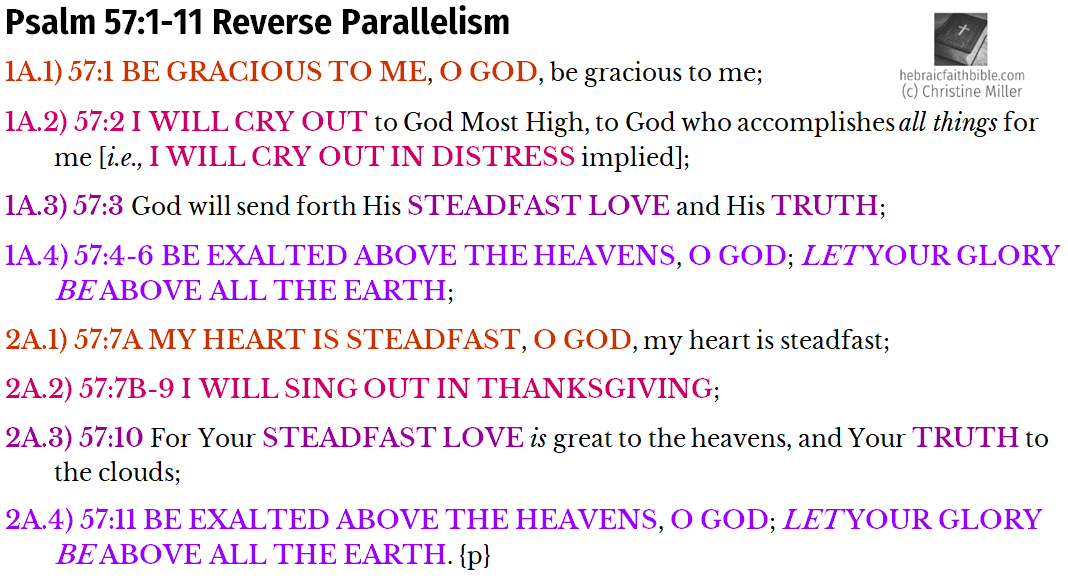
“Steadfast Love” translates the Hebrew Strong’s H2617 chesed, an abstract concept from Strong’s H2616 חסד chasad, “to be kind, merciful, or loyal.” The ancient pictographs:
chet ח = wall (outside, divide, half)
sin ס = thorn (grab, hate, protect)
dalet ד = door(enter, move, hang)
The parable the Hebrew Root Word is telling is of the wall (chet) of protection (sin) behind which one shelters when the door (dalet) is opened (see Joh 10:9).
When chesed is translated as “steadfast love” it emphasizes enduring, unwavering commitment (“His steadfast love chesed endures forever” Psa 136:1), highlighting love as an act of will and reliability.
When chesed is translated as “lovingkindness” it emphasizes affectionate kindness and a warm, personal benevolence (“Show Your marvelous lovingkindness chesed by Your right hand,” Psa 17:7).
When chesed is translated as “mercy” it emphasizes compassion and forgiveness, often undeserved (“Have mercy chesed on me,” Psa 51:1), though chesed’s scope includes loyalty and kindness beyond mercy alone.
Chesed is the primary word for this covenantal love-mercy-loyalty blend, but Hebrew has related terms with distinct meanings:
Rachamim (Strong’s H7356, from rechem, “womb”) is tender, often maternal compassions (“Can a woman forget her nursing child, that she should not have compassion rachamim on the son of her womb?” Isa 49:15), and often translated “mercy” (“Do not withhold Your tender mercies rachamim from me, O YHVH,” Psa 40:11). Unlike chesed, it’s rooted in visceral emotion, not only covenant loyalty.
Chanan (Strong’s H2603, “to be gracious”) is grace or benevolent favor (“Be gracious chanan to me” Psa 57:1).
Emet (Strong’s H571, “truth” or “faithfulness”) is loyalty or reliability, often paired with chesed (“All the paths of YHVH are steadfast love chesed and faithfulness emet,” Psa 25:10).
Hebrew lacks a term for judicial clemency, which is a Western concept derived from chesed and rachamim via the Greek Testament and the English Bible. Chesed combines loyalty (emet), kindness (chanan), and compassion (rachamim) as a unique covenant concept.
“YHVH, YHVH God, merciful (rachum) and gracious (chanan), slow to anger, and abounding in steadfast love (chesed) and faithfulness (emet).” Exo 34:6













Leave a Reply