
I have been carefully verifying the English translation of the Torah from the Masoretic Hebrew text preserved in the Leningrad Codex in preparation for The Paper submission (more on that coming up). You see, the English that I read for my own personal Bible reading, and for working out the Chiastic structures, I want it to be what the Hebrew actually says, without interpretive biases or theological overlays. Let the Bible say what it says! And doing so has turned up a few surprises.
And Abraham called the name of the place, The-LORD-Will-Provide; as it is said to this day, “In the Mount of the LORD it shall be provided.” Gen 22:14, NKJV
And Abraham called the name of that place Jehovah-jireh: as it is said to this day, In the mount of the LORD it shall be seen. Gen 22:14, KJV
The Chiastic structure for this paragraph pairs v. 14 with v. 8:
And Abraham said, “God will see to the lamb for Himself for a burnt offering, my son.” And the two of them walked together. Gen 22:8, verified English from the Masoretic, unpublished translation
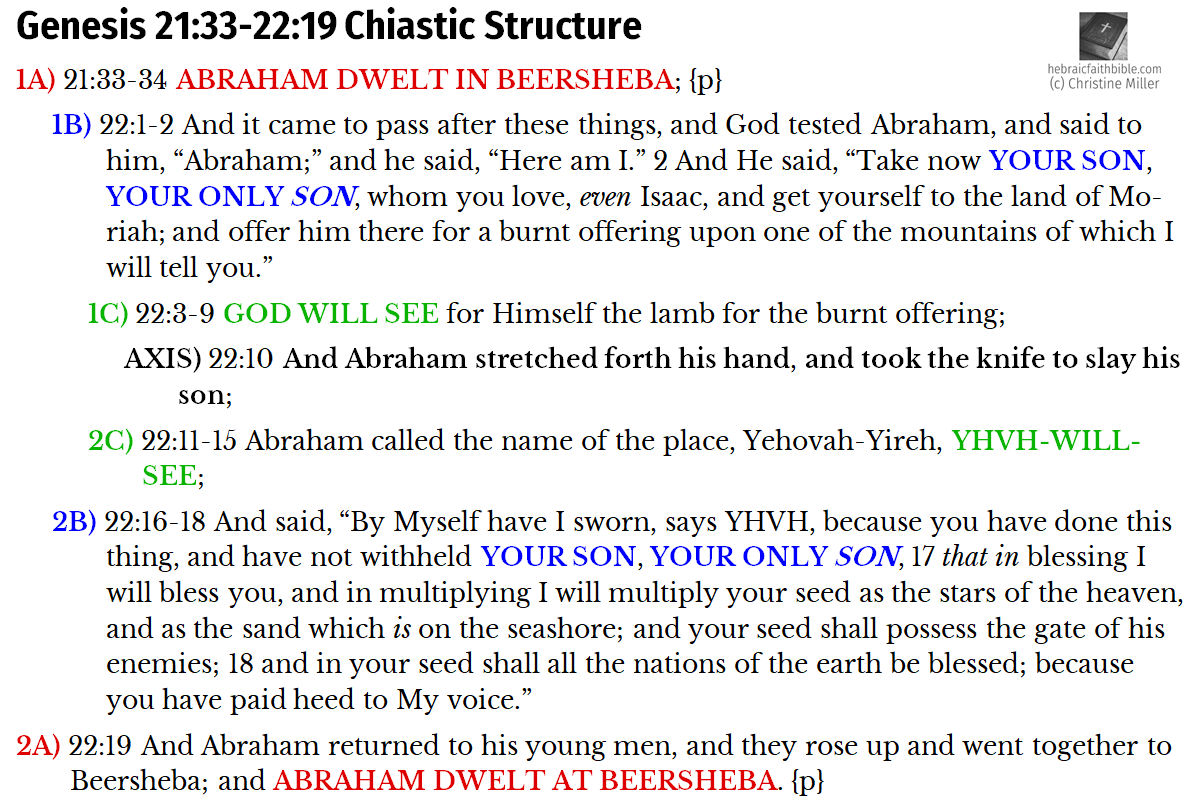
In v. 8, the Hebrew is יִרְאֶה־לוֹ הָאֱלֹהִים (yirʾeh-lô hāʾĕlōhîm), literally “will see to/for Himself.” The lô (to/for Him) signals His initiative: God perceives the need and sees to it Himself, with the verb implying corresponding action.
In v. 14, the Hebrew is יְהוָה יִרְאֶה (YHVH yirʾeh), literally “YHVH-Will-See.” The doer of the action is YHVH in the future tense, active voice: YHVH is the one who will see. In the proverb, the Hebrew is יֵרָאֶה (yērāʾeh), the passive voice, literally: “it shall be seen.” The implication is that the need is perceived, and then met.
The root of yirʾeh is ראה, raʾah, Strong’s H7200, “to see, perceive, behold,” not “provide.” Yet, as with שמע shama, Strong’s H8085, “to hear”—which in Hebrew implies not only receiving sound with the ears, but also the corresponding action or obedience that true hearing calls forth (“hear and obey,” Deu 6:4)—so ראה implies perception triggering a corresponding response. YHVH sees the need, as Abraham prophesied in v. 8, and because He truly saw, He provided the ram in v. 13. This History Prophesies of the Lamb God would provide for Himself (Joh 1:29), in the Father offering His Son, His only Son, whom He loves.
The more I dig into the Hebrew, the more respect I have for the KJV translators, frankly.




Leave a Reply