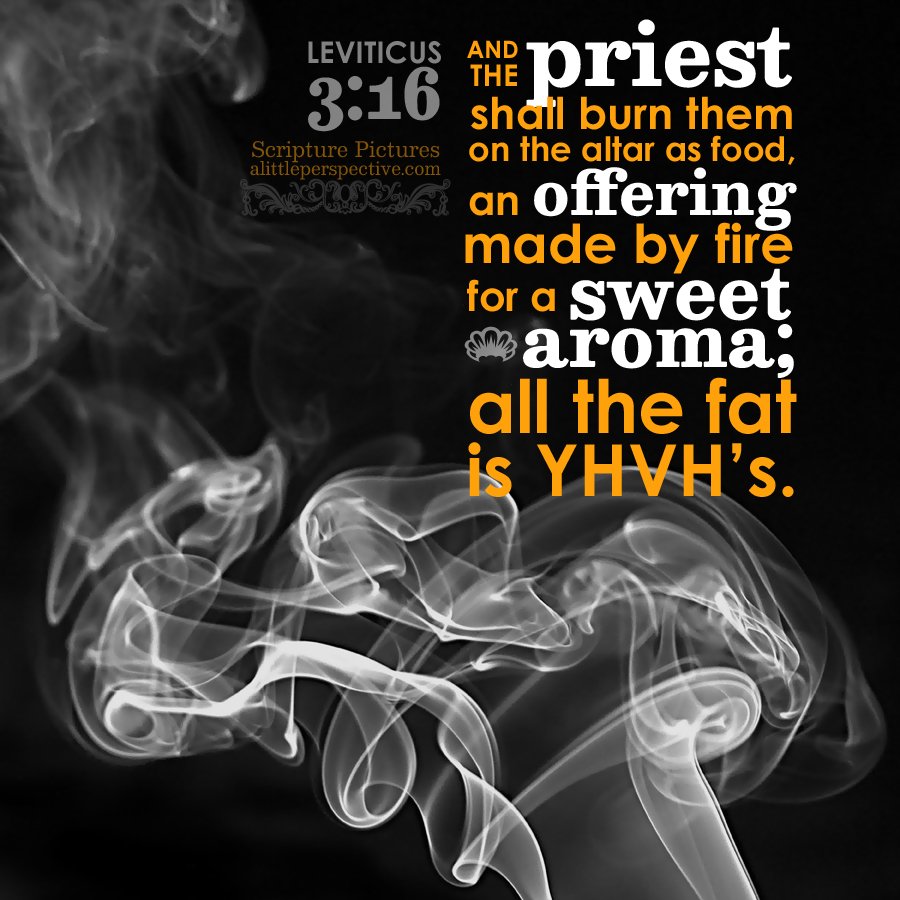
Read Leviticus 3:1-17 at Bible Gateway.
The Teaching Tools of Scripture
Genesis 1:1-2:3, The Teaching Tools of Scripture, part one and part two
Genesis 6, And the Strong Themes Teaching Tool
Genesis 1:1-6:8, Finding the Topic Themes of Scripture
HEBREW PARAGRAPH DIVISIONS
3:1-5 {p} Peace offering (shelem) of the herd
3:6-11 {p} Peace offering (shelem) of the flock
3:12-17 {p} Peace offering (shelem) of the goats 1:1-9 {s} Whole burnt offering (olah) of the herd
STRONG THEMES
None this week.
LEVITICUS 3:1-17 ZEVACH SHELAMIM CHIASTIC STRUCTURE
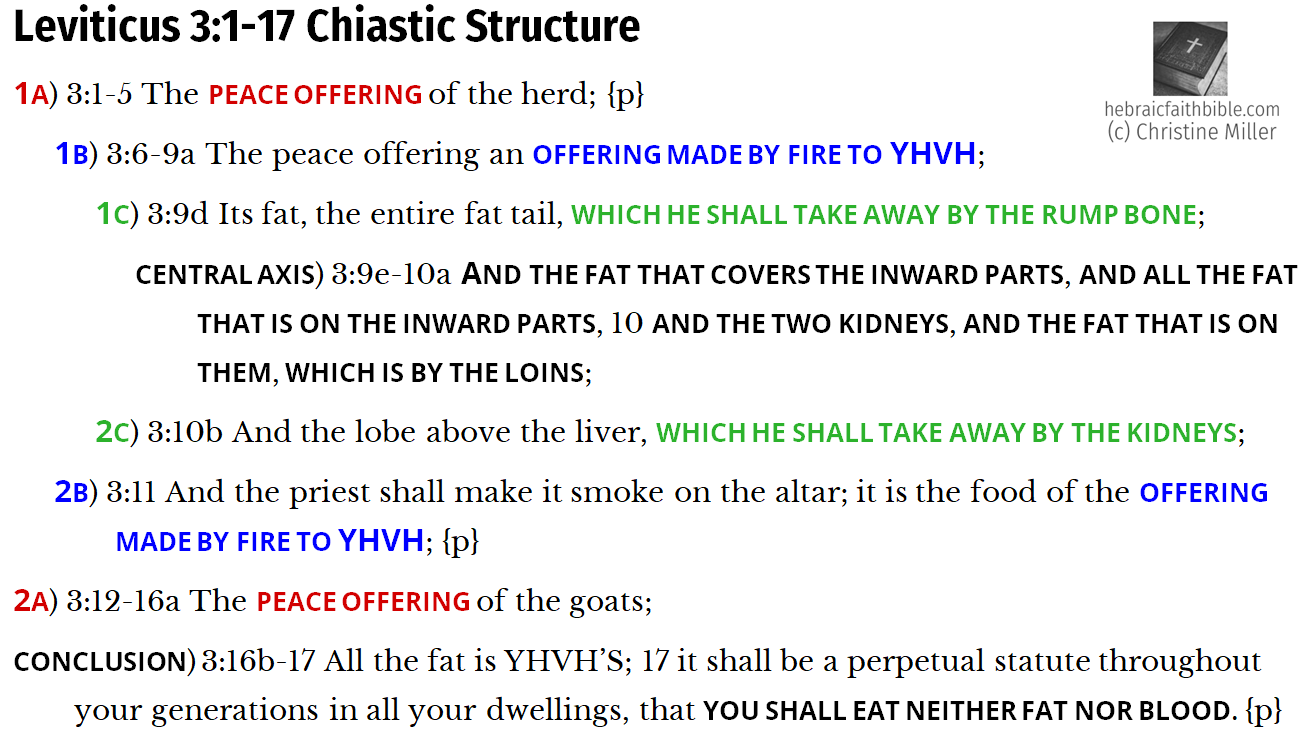
Download the fully expanded Lev 3:1-17 Triennial Zevach shelamim chiasm pdf (Coming …).
THEME of the PARASHAH
The law of the voluntary peace offering (shelem).
FINDING MESSIAH in TRIENNIAL ZEVACH SHELAMIM
When his offering is a sacrifice of peace offering, if he offers it of the herd; whether it is a male or female, he shall offer it without blemish before YHVH. Lev 3:1
In order to understand the biblical concept of the peace offering, we first have to understand the biblical concept of peace.
The word most often translated “peace” in our English Bibles, is the Hebrew שלום shalom, Strong’s H7965, an abstract concept meaning, “completeness, wholeness;” defined by its verbal root, שלם shalam, Strong’s H7999, “to be whole, sound, or safe.” The pictographs are shin + lamed + mem, but the Ancient Hebrew Lexicon says that the shin had been transposed from an original sin.
sin ס = thorn, thus grab, hate, protect
lamed ל = shepherd’s staff, thus teach, yoke, to, bind
mem ם מ = water, thus chaos, mighty, blood
The parable being told is of the thorns (sin) which the shepherd (lamed) drew from the sheep, taking away from them that which was causing pain or trouble (mem), OR of the thorns with which the shepherd surrounded the sheep, adding to them that which would prevent pain or trouble, for a shepherd surrounded the sheep with thorn bushes at night, in order to prevent predators from coming in among the flock.
Shalam means, taking away from, or adding to, whatever is necessary to make complete or whole; thus, to be at peace, or to be in a covenant of peace, is to be complete, with nothing missing that should be there, and with nothing added that should not be there.
Therefore, when YHVH adds blessing to, or subtracts cursing from a man, to bring him into a state of completion or wholeness, to bring him into shalom, the man responds with a peace offering, a shelem; thus some Bibles translate shelem as a “thank offering.” The shelem was a voluntary offering brought as worship by a man in right relation with God.
YHVH added blessing to us and subtracted cursing from us through Messiah, who brought us to wholeness. He became our peace, and when we accept Him, He becomes our thanksgiving.
The chastisement for our peace was upon Him, and by His stripes we are healed. Isa 53:5
Then the angel said to them, “Do not be afraid, for behold, I bring you good tidings of great joy which will be to all people. For there is born to you this day in the city of David a Savior, who is Christ the Lord. And this will be the sign to you: You will find a Babe wrapped in swaddling cloths, lying in a manger.” And suddenly there was with the angel a multitude of the heavenly host praising God and saying: “Glory to God in the highest, and on earth peace, goodwill toward men!” Luk 2:10-14
Therefore, having been justified by faith, we have peace with God through our Lord Jesus Christ. Rom 5:1
For He Himself is our peace, who has made both one, and has broken down the middle wall of separation. Eph 2:14
For it pleased the Father that in Him all the fullness should dwell, and by Him to reconcile all things to Himself, by Him, whether things on earth or things in heaven, having made peace through the blood of His cross. Col 1:19-20
For all things are for your sakes, that grace, having spread through the many, may cause thanksgiving to abound to the glory of God. 2 Cor 4:15
Therefore by Him let us continually offer the sacrifice of praise to God, that is, the fruit of our lips, giving thanks to His name. Heb 13:15
Lev chapters 1-3 are all part of the same speech, the laws for the burnt offering or olah, the grain offering or minchah, and the peace offering or shelem, all voluntary offerings brought by the man in right relationship with God. In Lev 4:1, YHVH begins a new speech. It is because the offerings which follow are a new class of offering.
ADDITIONAL READINGS
Psa 71 (my notes) | Eze 20 (my notes) | Rev 8 (my notes)
STUDIES in TRIENNIAL ZEVACH SHELAMIM
Leviticus 3, Bible for Beginners
Leviticus 3, Messiah our peace offering
Leviticus 1 through 3, The voluntary burnt offerings
RETURN to LEVITICUS INDEX
SCRIPTURE REVEALED SERIES by CHRISTINE MILLER:
THE LAW of LOVE | FINDING MESSIAH in TORAH | LEVITICUS in CHIASTIC STRUCTURE







Leave a Reply