Read 1 Thessalonians at Bible Gateway.
The book of 1 Thessalonians forms its own Chiastic Structure:
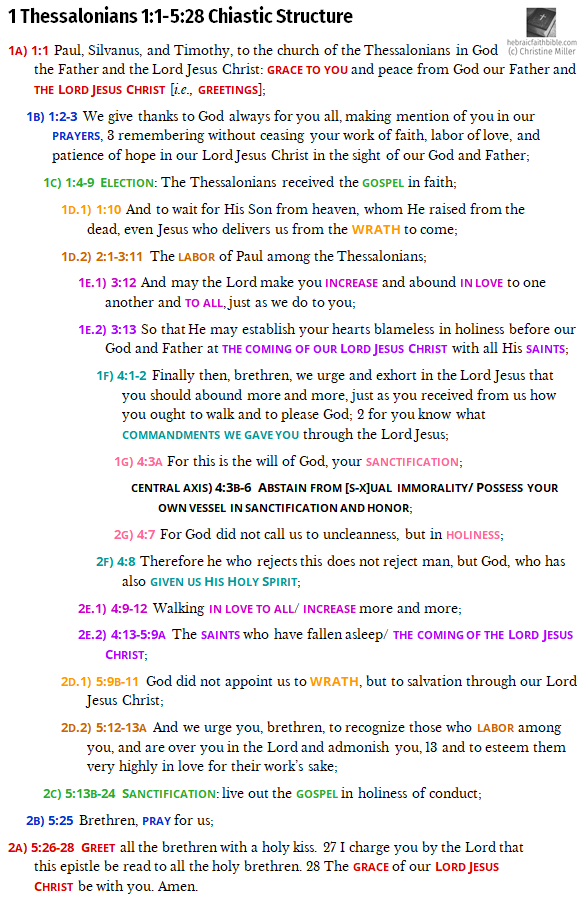
First, the C pair: 1c is about the salvation of the Thessalonians, and how they received the gospel Paul preached among them, in faith, so much so that it resulted in a noteworthy change in their lives and conduct, the report about them going out to all the surrounding district. 2c is about the sanctification of the Thessalonians, and admonitions on how to conduct their lives now that they have been saved, so that they will have a blameless testimony before God at the coming of the Lord Jesus. Salvation, justification, election by grace through faith is on one side of the coin, and sanctification, holiness, works proceeding out of that faith is on the other side of the coin. Faith and works are not enemies, but sisters.
The F pair: there is a way to walk, a conduct of life, that pleases God. The instruction of it is expressed by commandment (1F). Obedience to commandments does not save a man (right standing before God is by grace through faith), but sanctification or conduct in holiness is expressed by obedience to commandments. He who rejects this – he who rejects the commandments which instruct in righteous conduct – does not reject man, but God (2F). Then Paul says something interesting: “… who has given us His Spirit.” Just as faith and works are not enemies, but sisters, so commandment and the Spirit are not enemies. It is from the Spirit that the commandments originated which God voiced to Moses on Sinai, for out of the abundance of the heart, the mouth speaks (Luk 6:45).
I did not expect the central axis to be the admonition on [s-x]ual immorality and purity. There is a lot of politically correct pressure in society today to reject God’s standards of [s-x]ual purity expressed by God’s commandments, even in the Church. He who does so, does not reject man, but God who has given us these commandments by His Spirit.





Leave a Reply