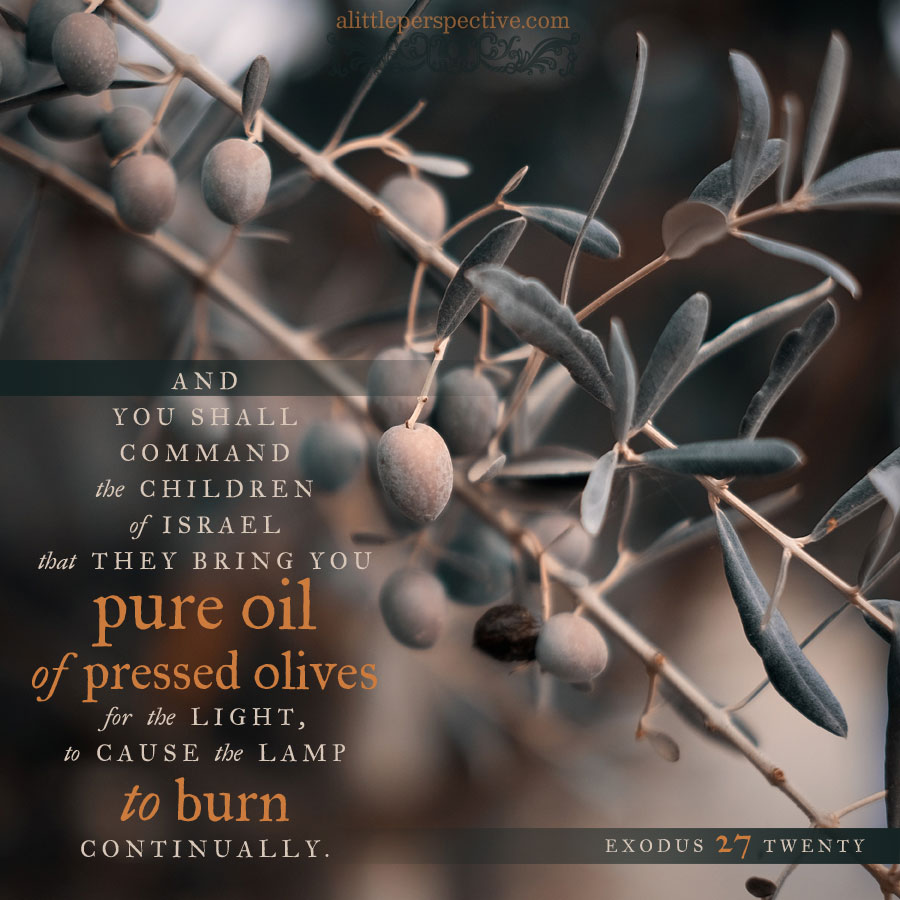
Read Exodus 27:20-28:43 at Bible Gateway.
The Teaching Tools of Scripture
Genesis 1:1-2:3, The Teaching Tools of Scripture, part one and part two
Genesis 6, And the Strong Themes Teaching Tool
Genesis 1:1-6:8, Finding the Topic Themes of Scripture
HEBREW PARAGRAPH DIVISIONS
27:20-21 {s} Oil for the lampstand/ continual tending of the lampstand’s light
28:1-5 {p} Aaron and his sons as priests/ their holy garments
28:6-12 {s} The pattern for the ephod
28:13-14 {s} The pattern for the chain and settings of gold
28:15-30 {s} The pattern for the breastplate
28:31-35 {s} The pattern for the robe of blue
28:36-43 {s} The pattern for the remaining garments
STRONG THEMES
26:15-28:5 {sx5+p} The form of the tabernacle and the function of the priesthood
EXODUS 27:20-28:43 TETZAVEH CHIASTIC STRUCTURE
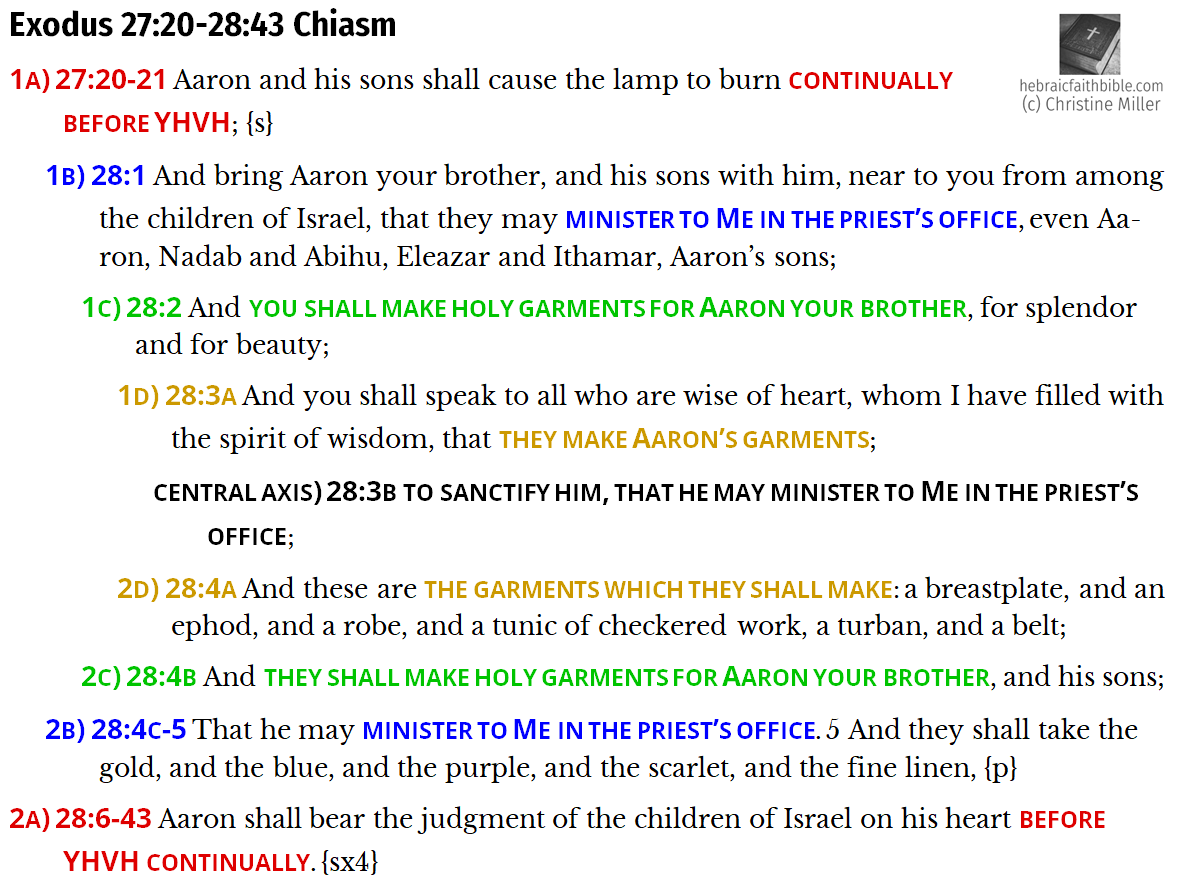
Download the fully expanded Exodus 27:20-28:43 Triennial Tetzaveh chiasm pdf (Coming …).
THEME of the PARASHAH
The priesthood attending to the continual things before YHVH.
FINDING MESSIAH in TETZAVEH
And they shall make the ephod of gold, blue, purple, and scarlet thread, and finely woven linen, the work of the skillful workman. Exo 28:6
Ephod is Strong’s H646 אפד , a concrete noun meaning, “priest’s vestment;” of possible foreign derivation, without a primitive verbal root. According to Gesenius, the 3-letter root of the noun is aleph + pey + dalet.
aleph א = the ox head, thus strength, power, leader
pey פ, ף = the mouth, thus open, blow, scatter, edge
dalet ד = the door, thus enter, move, hang
The story: Powerful (aleph) redemption; i.e. an opened (pey) door (dalet). When one is redeemed from slavery, the door is opened so that he can leave. The Ancient Hebrew Lexicon adds, “to bring back to an original state.”
The ephod is a garment unique to the priesthood. It served as a background for the remembrance stones to be borne before YHVH, two on the shoulders and twelve on the breastpiece. But the story of the ephod is a puzzle: powerful redemption? How is a vestment linked to powerful redemption?
Can a woman forget her nursing child, that she should not have compassion on the son of her womb? Yes, they may forget, yet will I not forget you. Behold, I have engraved you upon the palms of My hands; your walls are continually before Me. Isa 49:15-16
The remembrance stones were engraved with the names of the children of Israel. And in Yeshua we have been engraved upon the palms of His hands, where the scars of His crucifixion remain. Engraved, so as to be kept in remembrance, or not forgotten, before YHVH.
Scarlet is from a two-word phrase in Hebrew:
Strong’s H8144 שני shaniy, a concrete noun meaning, “stuff dyed scarlet;” of uncertain derivation. The 3-letter root of the noun is shin + nun + yud.
shin ש = two front teeth, thus sharp, press, eat, two, again
nun נ ן = the seed, thus continue, heir, son
yud י = the closed hand, thus work, throw, worship
The story: The female scarlet worm pressed her body down (shin) onto the ilex tree or leaves, affixing herself firmly. She then deposited her eggs (nun) beneath her body, which enclosed them (yud), protecting them until they hatched.
“When the female of the scarlet worm species was ready to give birth to her young, she would attach her body to the trunk of a tree, fixing herself so firmly and permanently that she would never leave again. The eggs deposited beneath her body were thus protected until the larvae were hatched and able to enter their own life cycle. As the mother died, the crimson fluid stained her body and the surrounding wood. From the dead bodies of such female scarlet worms, the commercial scarlet dyes of antiquity were extracted. What a picture this gives of Christ, dying on the tree, shedding his precious blood that he might ‘bring many sons unto glory’ (Hbr 2:10)! He died for us, that we might live through him! Psa 22:6 describes such a worm and gives us this picture of Christ. (cf. Isa 1:18).”
– Henry Morris; Biblical Basis for Modern Science, Baker Book House, 1985, p. 73
Strong’s H8438, towla, a concrete noun meaning, “worm;” used often interchangeably to mean the female scarlet worm above. The blue, purple, and scarlet found throughout the instructions for the tabernacle, and the priestly garments, is a prophetic metaphor of the Messiah, His deity, and His action as the mediator between God and men. Blue represents God; red represents man (the Hebrew noun, adam, “man,” is from the primitive root adam, “to be red”). The purple is always between them. Blue and red combined create purple. Purple represents the Messiah, God and man together. And after all, that is the reason for the tabernacle, and the priesthood – that the separation between God and man is ended, and it is ended, in Him who is our Priest forever.
The scarlet dye was applied to white wool to make it scarlet … and the blood of Messiah is applied to us, to make we who are stained scarlet with sin, to be white as wool.
“Come now, and let us reason together,” Says the Lord, “Though your sins are like scarlet, They shall be as white as snow; Though they are red like crimson, They shall be as wool.” Isa 1:18
ADDITIONAL READINGS
Psa 59 (my notes) | Jer 11 (my notes) | Heb 3 (my notes)
STUDIES in TETZAVEH
Exodus 25 through 27, The natural picture of the tabernacle
Exodus 26:15-28:5, {sx5+p} Strong theme
Exodus 27, Bible for Beginners
Exodus 27 and 28, The tabernacle as a prophetic type
Exodus 28, Bible for Beginners
Exodus 28:6-12, {s} Powerful redemption
RETURN to EXODUS INDEX
SCRIPTURE REVEALED SERIES by CHRISTINE MILLER:
THE LAW of LOVE | FINDING MESSIAH in TORAH | EXODUS in CHIASTIC STRUCTURE








Leave a Reply